
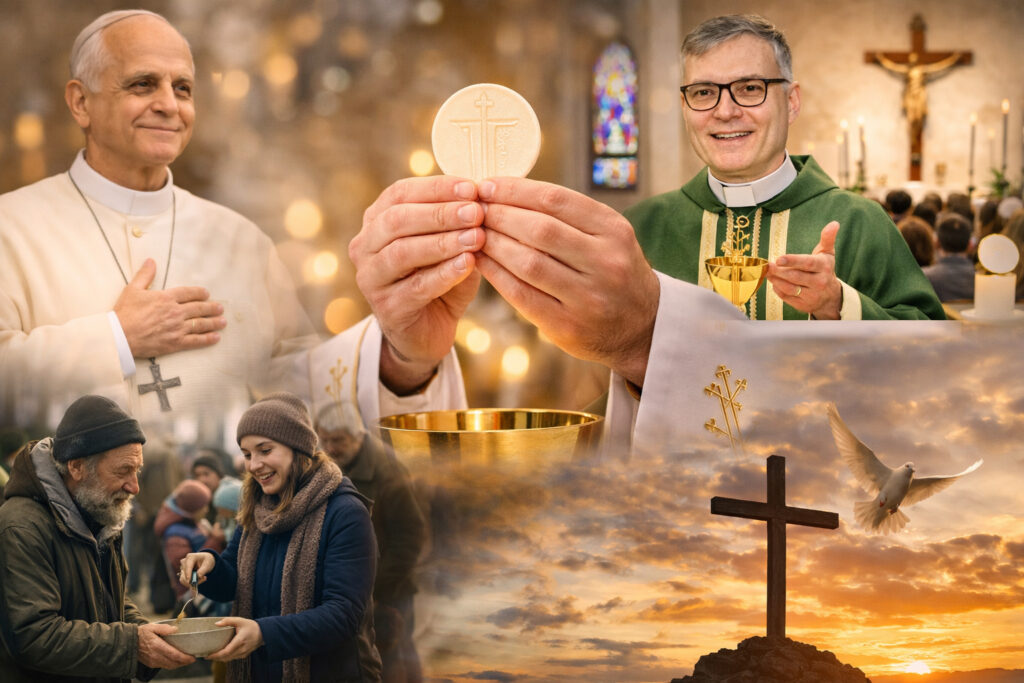
Before I move on to why I love the Catholic Church, it’s important to acknowledge something up front: the Church is not perfect. Loving the Church doesn’t require pretending it is. In fact, the opposite is true—love invites honesty. The Church, like every religion or spiritual movement, is made up of human beings, and therefore carries the marks of our imperfections.
Though I don’t want this piece to focus on the negative, I also don’t want to pretend the Catholic Church does not have areas that deserve scrutiny.
My critiques of the Catholic Church
Women Clergy
As much as I appreciate the Catholic Church’s leadership, there’s no denying the impact of having an all-male leadership whose formation is shaped largely within male-dominated structures that remain opposed to women’s ordination. While Pope Francis has taken meaningful steps to elevate women into significant leadership roles, there has been little movement regarding the Church’s position on women being ordained.
The Church teaches that because Jesus chose only men as his apostles, it does not have the authority to ordain women. I respect the desire to remain faithful to Christ’s example. At the same time, I recognize that first-century Jewish culture was strongly patriarchal, and that a public, authoritative role for women would not have been accepted in that context. Jesus often worked within cultural limits while quietly pushing against them.
Other Christian communities read that same moment differently. They see Jesus’ choice as descriptive of the cultural realities of his time, not necessarily prescriptive for all time, and point to how often Jesus elevated and included women in ways that were quietly radical.
Clericalism
Clericalism is the overextension of clergy power without proper accountability. It can also show up in the laity’s tendency to defer too much responsibility to priests. Pope Francis has called clericalism a “perversion” in the Church.
I have deep respect for many priests I’ve known—especially my current parish pastor, who lives his vocation with humility and service. But I’ve also seen enough to know that the misuse of authority is real. I’m hopeful that synodality, which I’ll highlight later, can help restore a healthier balance.
LGBTQ+ Inclusion
Another area that continues to weigh on me is the Church’s relationship with the LGBTQ+ community. I believe deeply in the full dignity and inclusion of LGBTQ+ persons within the life of the Church—not at the margins, but fully welcomed and embraced. I’ve been encouraged by the more pastoral tone of Pope Francis, especially in moments like his now well-known “Who am I to judge?” comment, and more recently in his approval of pastoral blessings for same-sex couples, even as the Church maintains its teaching on marriage. These feel like meaningful steps—small, but real.
And yet, it also seems clear that there is still a journey ahead. I can’t help but notice how, in many parts of the wider Christian world, there is a growing movement toward deeper inclusion—one that I and many believe is being guided by the Holy Spirit. I remain hopeful that the Catholic Church will continue to listen, discern, and grow in this area, as it has in others, always seeking to reflect more fully the love of Christ for every person.
I’m not saying these are the only issues within the Catholic Church, but for me, they are among the most significant. I say this while also recognizing that the Church has made meaningful progress in becoming more open and accountable in its response to sexual abuse. There is still work to be done, but there has been real movement over the past decade.
Ultimately, my hope for the Catholic Church rests in its leadership and in the guidance of the Holy Spirit. While I have appreciated and respected the popes of my lifetime—Paul VI, John Paul II, and Benedict XVI—their leadership did not move the Church in a direction that meaningfully addressed the concerns I’ve raised here. In many ways, they maintained the status quo.
And yet, despite all of this, I still find myself deeply loving the Catholic Church.
Why I love the Catholic Church
Pope Francis & Pope Leo
The leadership of Pope Francis has been a bright spot for me. His papacy is marked less by doctrinal change and more by a shift in tone and emphasis—particularly his focus on the poor, his environmental leadership through Laudato Si’, and his commitment to synodality: a listening Church that seeks to include the voices of all the baptized.
When Pope Francis was elected in 2013, I was serving as a pastor in another denomination. I began following him closely, and it didn’t take long to sense that his leadership would be a positive influence. His decision early in his papacy to wash the feet of prisoners—including women, young people, and non-Catholics—was a powerful expression of humility and service. While it drew criticism from some, it spoke volumes to many others, especially those outside the Church.
His emphasis on synodality—bringing together laity, clergy, women, and young people to discern what the Holy Spirit is saying to the Church—has been, for me, one of the most exciting developments in my lifetime. It’s something I’ve become deeply passionate about, even launching a website, synodalitypilgrims.ca, to help promote it.
I’m also encouraged by the early leadership of Pope Leo XIV, who has made it clear that synodality is here to stay. His humility and servant leadership offer a hopeful path forward for the Church.
The Mass
This blog cannot fully express how important the Mass is to me. I’ve written elsewhere about leaving the Catholic Church in 2002 and eventually becoming a pastor in another denomination. There were many reasons for my departure, but the Mass was never one of them. I’ve loved it since I was a young boy, and even during my years away I continued to attend occasionally.
In many ways, my return to the Church was rooted in a renewed appreciation for the Mass.
I love how the Mass is structured, and in particular its focus on Jesus. For many, the liturgy can feel repetitive because it’s the same week after week. For me, that’s part of its beauty. There’s something grounding in its rhythm—its prayers, its reverence, and its focus on the Eucharist. I especially love coming forward for communion alongside my brothers and sisters in Christ.
The Church’s Teachings
What I’ve come to love about the Catholic Church are its teachings—especially its unwavering insistence on the dignity of every human person. That belief shapes so much of what the Church stands for: a preferential love for the poor, a call to see those on the margins not as problems to be solved, but as people to be encountered and honoured. It reminds us that we belong to one another, that we are not meant to walk through life alone, and that our faith is something lived in community, not in isolation.
I love the Church’s teaching on peace and its opposition to injustice, war, and the death penalty.
At its best, the Church reflects a vision of humanity where no one is disposable and everyone matters.
I’m also drawn to the Church’s sense that grace is woven into the fabric of ordinary life—that God meets us not just in the extraordinary, but in the everyday. There’s a deep belief in mercy at its core, that no one is beyond redemption, that we are always being invited, no matter how far we’ve wandered or perhaps never been part of church. I’ve also come to appreciate the Church’s confidence that faith and reason belong together—that belief is not a retreat from thinking, but an invitation to go deeper into truth.
And in recent years, I’ve been inspired by its growing call to care for creation, recognizing the world as a gift entrusted to us, one that connects us all and calls for both gratitude and responsibility.
The People
When I left the Church, I didn’t take the time to fully consider the people. I was too focused on the failures of leadership, particularly around the handling of sexual abuse. In doing so, I lost sight of the faithful men and women who make up the Church.
Since returning, the people I worship with have become an integral part of my life. Whether through my involvement with the Society of Saint Vincent de Paul or simply through the quiet presence of others at Mass—the lectors, greeters, Eucharistic ministers, choir members, and so many others—I see a deep and sincere love for God expressed in ordinary ways.
Even those I don’t know everyone personally, especially given I’m part of such a large parish—the familiar faces I see week after week—have become part of my faith journey. Their presence encourages me.
I know God’s Church is much bigger than the Catholic Church alone. I’ve encountered faithful believers in many Christian communities, and I consider them part of my extended church family. But the Catholic Church is home. And despite its imperfections it remains the place where I continue to encounter Christ deeply.
Photo credit: Collage created by ChatGPT from my instructions

You express many of my own thoughts and feelings about the Church in such a simple and beautiful way.
Thanks Bernie. It’s the people that make it church beautiful.